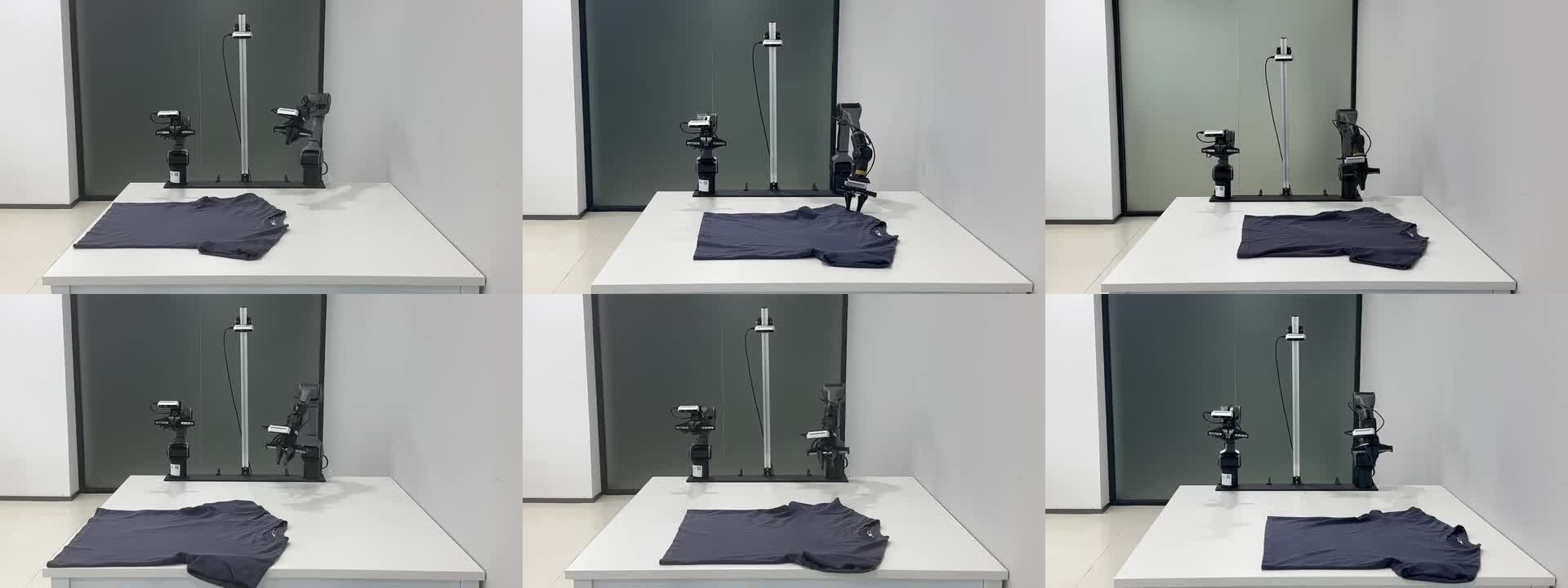
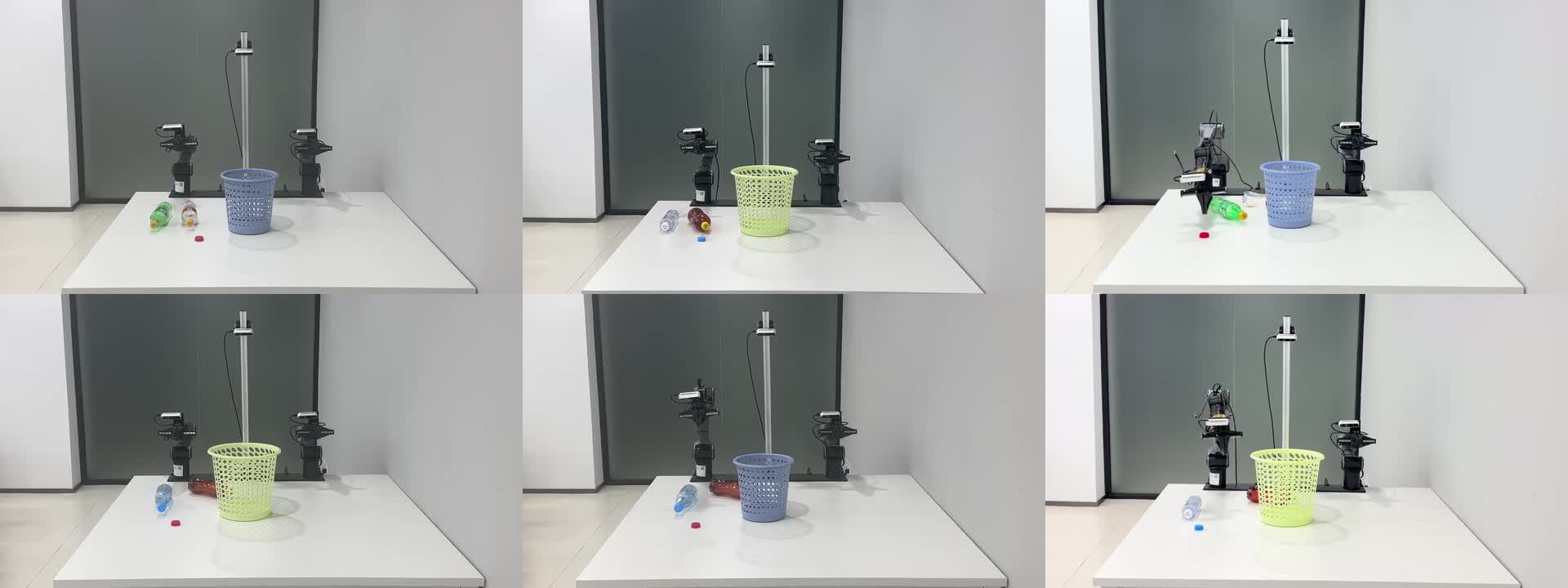
Visually plausible video predictions can mislead policy refinement when they fail to reflect the input actions. R²-WAM first improves the consistency of predicted futures with input actions, then uses these futures to select inferior action samples for negative fine-tuning.
R²-WAM extends video prediction from representation learning to consequence feedback. Results and execution sequences illustrate its performance in simulation and on real robots.
03 / METHOD
Predictive repair and action rejection
R²-WAM is a two-stage post-training framework, without additional environment interaction or changes to the inference procedure.
01
Predictive repair
Given the same observation and demonstrated action, compare the predicted future with the observed robot behavior. A kinematic alignment score selects predictions with substantial motion discrepancies for negative fine-tuning.
Video expert refinement02
Action rejection
With the repaired video expert frozen, compare predicted task progress for sampled and demonstrated actions from the same initial observation. Select sampled actions that fall below the demonstrated reference by a prescribed margin for negative fine-tuning.
Action policy refinement
Both stages retain flow matching on demonstrations and apply negative fine-tuning to selected generated samples.
Predictive repair uses observed futures to identify action-inconsistent predictions. Action rejection uses the repaired video expert to select inferior actions by comparing their predicted progress with the demonstrated reference.
04 / RESULTS
Experimental results
Simulation performance across 50 RoboTwin 2.0 tasks, alongside real-world evaluation over seen and unseen conditions.
Simulation results
RoboTwin 2.0
Average success · Clean and randomized settings
Action-conditioned Fast-WAM 90.5%
Fast-WAM 91.9%
LingBot-VA 92.3%
R²-WAM 93.8%
REAL-WORLD FOLD SHIRT
87.5%
Average success across four evaluation conditions.
Fast-WAM0%
20 autonomous trials per condition per method. Four conditions vary initial position and object instance.
R²-WAM achieves 93.8% success in clean environments and 93.7% under randomization, improving over action-conditioned Fast-WAM by 3.2 and 3.3 percentage points, respectively.
Predictive repair improves consequence feedback
More reliable action negatives
Actions selected for rejection using imagined consequences are compared with execution-based STEAM judgments.
Negative selection at the training margin
Video expert
Precision
Recall
Continued flow matching
64.6%
35.5%
Predictive repair
69.8%
50.6%
Greater gains from action rejection
Success gains from adding action rejection, with and without predictive repair.
Improvement in percentage points
Video expert
Clean
Randomized
Without repair
+0.3
+0.2
With repair
+1.9
+2.3
Repair improves agreement between imagined and execution-based action judgments, while action rejection yields larger policy gains with the repaired video expert. Together, these results support repair as a basis for more reliable consequence feedback during action post-training.
Real-world results and qualitative analysis
On the long-horizon Fold Shirt task, R²-WAM achieves 87.5% average success, while Fast-WAM and Motus complete none of the evaluation trials. It also outperforms the VLA baselines across all four conditions. On Clean Table, R²-WAM achieves 70.0% success when both object position and instance vary, compared with 40.0% for the strongest baseline, π₀.₅.
(a, b) Success rates on Fold Shirt and Clean Table. (c) Fast-WAM executions and predicted consequences of actions from Fast-WAM and R²-WAM during shirt folding. Human intervention enables later-stage analysis in (c); these rollouts are excluded from success rates.
During shirt folding, Fast-WAM grasps or lifts the garment but fails to complete the subsequent fold or pull. The repaired video expert predicts a similar lack of progress for these actions, whereas predictions for R²-WAM actions show forward folding, garment pulling, and lateral folding. These examples suggest that predicted consequences can help identify stalled actions for rejection during post-training.
BibTeX
@misc{xu2026r2wam,
  title         = {{R$^2$-WAM}: Repair-and-Reject Post-Training
                   for World Action Models},
  author        = {Ruiyan Xu and Haisheng Su and Sixu Lin and
                   Zhaokun Yue and Chengming Hu and Xin Jin and
                   Guiliang Liu},
  year          = {2026},
  eprint        = {2610.04913},
  archivePrefix = {arXiv},
  primaryClass  = {cs.RO},
  url           = {https://arxiv.org/abs/2610.04913}
}